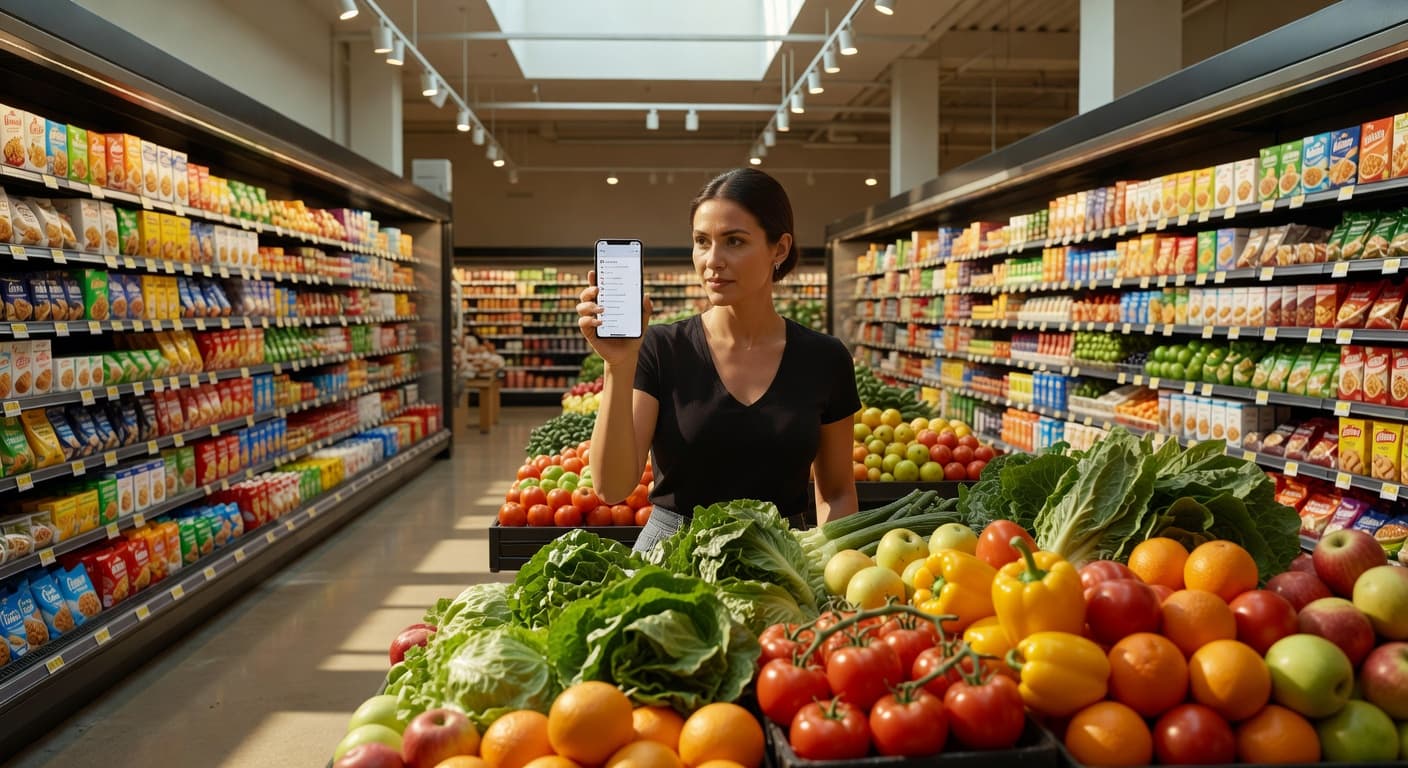
The grocery store is where most healthy eating plans fall apart. Not in a dramatic way — no one walks in planning to buy chips and frozen pizza. It happens in small decisions, one aisle at a time, over 30 minutes of low-level psychological pressure you barely notice.
The people who design supermarkets know this. The layout, the lighting, the smells, the shelf heights, the cart size — none of it is accidental. It has been refined over decades of behavioral research with one goal: maximize what you spend. That goal usually works against what you are trying to eat.
Understanding how it works is the first step to not being manipulated by it.
The Architecture of Influence
Most large grocery stores follow the same general layout: fresh produce at the entrance, meat and dairy along the back wall, staple goods in the center aisles, and highly processed snack foods and beverages spread throughout. This is not intuitive — it is strategic.
Produce at the entrance creates what researchers call a “licensing effect.” You put broccoli and apples in your cart first. You feel virtuous. That psychological credit gets spent in the chip aisle ten minutes later. Studies on behavioral licensing show that people who make one virtuous choice are significantly more likely to follow it with an indulgent one. The store layout exploits this reliably.
The back wall placement of milk, eggs, and meat is not about storage temperature — it is about forcing you to walk through the entire store to reach essentials. Every aisle you pass is an opportunity to buy something you had no intention of buying. Researchers at Cornell University found that the average shopper makes 59% of all in-store purchases on impulse — items not on any list, triggered entirely by exposure.
End Caps and Eye Level: The Hidden Persuaders
End caps — the displays at the end of each aisle — are among the most valuable real estate in retail. Manufacturers pay significant fees for that placement. End caps generate roughly 30–40% of category sales despite representing a fraction of shelf space. What is on end caps is almost never produce or lean protein. It is packaged food with high margins and strong brand recognition.
Eye-level shelf placement follows the same logic. In the cereal aisle, the products at adult eye level are the high-margin, high-sugar options. The lower-sugar, higher-fiber options — when they exist — are on the bottom shelf. Children’s cereals are placed at child eye level. This is not coincidence. It is decades of shelf-space negotiation between manufacturers and retailers.
A 2015 systematic review in the *British Medical Journal* found that repositioning healthier items to eye level and less healthy items to lower shelves significantly increased healthy food sales without any other intervention. The food itself did not change. Only the placement changed.
Decision Fatigue and the Checkout Zone
You arrive at the checkout lane having made hundreds of small decisions over the past 30 minutes. Research on decision fatigue — the documented cognitive exhaustion from repeated choices — shows that by the end of a shopping trip, self-regulation is measurably impaired. Your ability to resist impulse purchases is weakest exactly where the store puts candy, gum, and sports drinks.
A 2018 study in the *Journal of Marketing Research* found that checkout lane product placement significantly increased impulse snack purchases, and that the effect was strongest in shoppers who had spent the most time in the store. Tired, decision-depleted people grab what is in front of them.
This is why grocery stores that removed candy from checkout lanes — several UK chains did this voluntarily — saw meaningful reductions in impulse snack purchases. The food did not become less appealing. The exposure was simply removed.
The Health Halo Trap
Terms like “natural,” “artisan,” “farm fresh,” “make with whole grains,” and “good source of fiber” carry no regulatory definition in the United States. The FDA has tried repeatedly to define “natural” and abandoned the effort. These labels are marketing, not nutrition.
The health halo effect is well-documented: labeling a food as “healthy” — even by implication — causes people to underestimate its calorie content and eat more of it. A landmark Cornell study by Brian Wansink found that people estimated “low-fat” labeled snacks to have 40% fewer calories than they actually did, and ate 28% more of them as a result.
Organic potato chips are still potato chips. Whole grain crackers with added sugar are still primarily refined starch. “Lightly sweetened” cereals can have 12 grams of added sugar per serving. Reading the nutrition label — specifically the ingredients list and added sugar line — matters far more than front-of-package marketing.
The Environment Engineering You Don’t Notice
Beyond shelf placement, stores use several environmental levers that operate below conscious awareness.
Smell: Many stores pump artificial bakery scent near the entrance. The smell of baking bread triggers appetite and increases overall food purchases, even in people who were not hungry. A 2016 study in the *Journal of Marketing Research* found that ambient food smells increased caloric purchases by a significant margin.
Cart size: Larger carts lead to larger purchases. A Cornell study found that doubling cart size increased purchases by 40%. Most carts have grown substantially over the past 30 years. There is no nutritional reason a cart needs to hold 200 items.
Music tempo: Slower music causes shoppers to move more slowly through the store, increasing time spent and units purchased. A classic study by Ronald Milliman in the *Journal of Marketing* found that slow-tempo background music increased sales by 32% compared to fast-tempo music. Most supermarkets play slower music during peak shopping hours.
Lighting: Produce sections use warm, bright lighting to make fruits and vegetables appear more vibrant. Meat cases use specific lighting wavelengths to make proteins appear fresher and redder. The food looks better than it will on your counter at home.
What the Research Says About Lists
A 2011 study in the *Journal of Nutrition Education and Behavior* found that shopping with a grocery list was significantly associated with healthier food purchases and lower BMI — independent of income, education, or household size. The list effect is real and large.
A 2023 analysis of supermarket purchase data found that shoppers without a structured plan purchased approximately 40% more calorie-dense items per trip than those with a written or app-generated list. The difference was not in awareness or intention — both groups knew what “healthy” meant. The difference was in the structure that prevented in-the-moment override.
A pre-written list reduces the number of in-store decisions you have to make. Fewer decisions means less decision fatigue. Less decision fatigue means fewer impulse purchases. This is not willpower — it is decision architecture.
What to Do
1. Never shop without a list — and make it specific. Not “vegetables” but “broccoli, spinach, bell peppers.” Vague lists leave room for substitution. Specific lists do not.
2. Shop the perimeter first, then go in for only what’s on your list. Produce, protein, and dairy line the edges of most stores. The center aisles exist primarily to expose you to processed food. Treat them as a last resort, not a route.
3. Do not shop hungry. A 2013 Cornell study found that hunger increased calorie-dense food purchases by 64%, regardless of whether shoppers were buying groceries or non-food items. Eat something before you go.
4. Read labels, not packaging. Front-of-package claims are marketing. The nutrition facts panel and ingredients list are regulated. Added sugar, sodium, serving size, and ingredient order tell you what you actually need to know.
5. Consider grocery delivery or curbside pickup. Removing yourself from the store environment removes all of the above influences at once. You shop from a list on a screen, unaffected by smells, music, end caps, or checkout candy. Multiple studies have found that online grocery orders contain fewer impulse items and more produce than in-store purchases.
The Bottom Line
Difficulty eating well in a grocery store is not a character flaw. It is the expected outcome of spending 30 minutes in an environment specifically engineered to override your intentions. The research is not subtle about this. Stores are designed by behavioral scientists whose job is to maximize what you buy — not what you intended to buy when you drove to the parking lot.
The countermeasure is structure. A specific list, decided before you enter. A plan that takes the decisions out of the store and makes them at home, when you are not hungry, not fatigued, and not surrounded by environmental cues designed by professionals.
MyNutriCart builds that structure automatically. Your weekly meal plan generates a complete, section-organized grocery list based on your health profile, store selection, and budget — decided at home, sent to your cart in one tap. No decisions in the chip aisle.
References: Cohen DA & Babey SH, Obes Rev 2012 (supermarket design and behavior); Wansink B & Chandon P, JACR 2006 (health halo effect); Milliman RE, J Marketing 1982 (music tempo); Spence C et al., J Marketing Research 2016 (ambient food odors); Dubé L et al., JNEB 2011 (grocery lists and healthy eating); Tal A & Wansink B, JAMA Intern Med 2013 (shopping while hungry).